


PSHE Curriculum Overview
PSHE (Personal, Social, Health and Economic) education at St Benedict’s Catholic Primary School is taught in line with the statutory guidance for PSHE education (2020) and the Development Matters (2021). We provide a high-quality PSHE and RSE programme which equips the children with knowledge of how to keep themselves healthy, safe and prepared for life. The PSHE curriculum is driven through three main strands as directed by the PSHE Association; health and wellbeing, relationships and living in the wider world. Relationships and Sex Education (RSE)is also taught through our TenTen Programme of study alongside the (National Curriculum, 2014) and it is led by the teachings of the Diocese.
PSHE Progression of Skills Map
Pastoral and Therapeutic Care
At St Benedict’s our pupils have access to a range of Pastoral and Therapeutic services to help develop positive mental health and well-being. Some sessions run within class however some children complete therapeutic 1:1 sessions out of class. Please see some of the wellbeing services we offer below:
- Lego Therapy
- Drawing and Talking
- Meditation Through Prayer
- PSHE sessions/RSE sessions
- Circle Time
- Trusted Adults
- Mindfulness Colouring
We also have two members of staff who are fully trained and certified Mental Health First Aiders.
Mindfulness and Wellbeing
Wellbeing and Mental Health
At St Benedict’s, through our RSE curriculum, we help children to recognise worry, manage difficulties and cope with stress. This helps them to develop a more mindful awareness in turn encouraging children to recognise what is going well in their lives and to flourish.
Concentration and Cognition
Mindfulness helps us to understand and direct our attention with greater awareness and skill. This may improve the capacity of children to concentrate and be less distracted.
Social and Emotional Learning
Mindfulness can also be taught in the context of PSHE, RSE and through texts chosen from the Power of Reading scheme. It helps children to develop a greater awareness of relationships, in and out of school, and how to manage them as well as offering a richer understanding of things like self-esteem and optimism.
Behaviour
At St Benedict’s we understand that mindfulness may help the children to self-regulate more effectively, recognising their range of feelings, manage impulsivity, and reduce conflict and oppositional behaviour.
Restorative Justice
What is Restorative Justice?
Restorative Approaches are inspired by the philosophy and practices of Restorative Justice which aims to repair harm caused to relationships by conflict. Crucially, it is believed that Restorative Justice can be best achieved by focusing on the harm caused, rather than assigning blame and dispensing punishment.
At St Benedict’s, we have adopted many Restorative Justice approaches as they align with the ethos of our Catholic faith. You will see the word ‘Pax’ inscribed on our school logo, which means ‘Peace to You’. We believe that peace and forgiveness come hand in hand with Restorative justice, which in turn lends itself to a harmonious learning environment.
Restorative Language
When pupils find themselves in conflict or upset we will ask them:
- What happened?
- What were you feeling when it happened?
- How do you feel about it now?
- What needs to happen to put this right?
- What will you do differently next time?
We might also say to our pupils:
- What would you think if this happened to you?
- What other choice could you have made?
- How could you make sure this doesn’t happen again?
At St Benedict’s we aim to develop the child’s ability to tell the truth, to take responsibility and accountability, to show empathy and to resolve conflict in a positive learning environment. We believe this can be done efficiently and effectively by using the Restorative Justice Approaches.
Zones of Regulations
At St Benedict’s, we encourage children to use ‘The Zones of Regulation’ which is an international intervention that helps children to deal with difficult emotions.
Self-regulation can also go by the names of ‘self-control’, ‘impulse management’ and ‘self-management’.
From time to time, all of us (including adults) find it hard to manage strong feelings such as worry, anger, restlessness, fear or tiredness, and this stops us from getting on with our day effectively. Children who feel these emotions often find it hard to learn and concentrate in school. The Zones of Regulation aims to teach children strategies to help them cope with these feelings so they can get back to feeling calm and ready to learn. These coping strategies are called ‘self-regulation’.
What are the different Zones?
Blue Zone: low level of arousal; not ready to learn; feels sad, sick, tired, bored, moving slowly.
Green Zone: calm state of alertness; optimal level to learn; feels happy, calm, feeling okay, focused.
Yellow Zone: heightened state of alertness; elevated emotions; has some control; feels frustrated, worried, silly/wiggly, excited, loss of some control.
Red Zone: heightened state of alertness and intense emotions; not an optimal level for learning; out of control; feels mad/angry, terrified, yelling/hitting, elated, out of control.
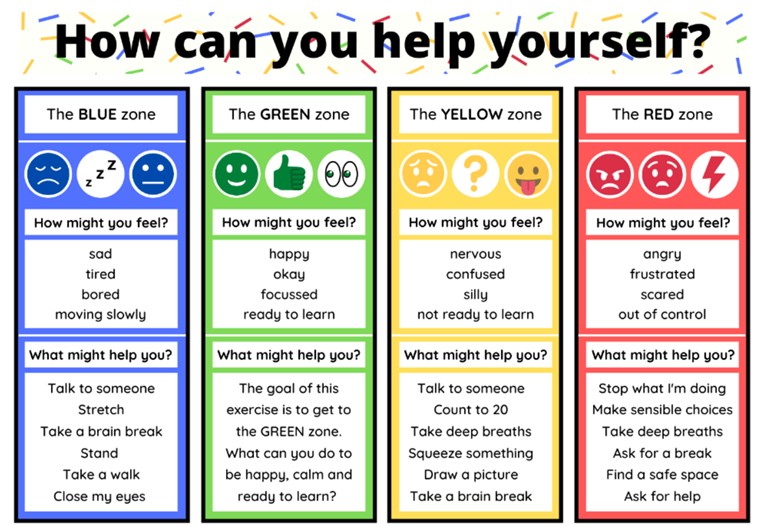
If you are interested in learning more about ‘The Zones of Regulation’ please use the link below:
https://www.zonesofregulation.com/uploads/3/4/1/7/34178767/english_reproducible_b.pdf
The Incredible 5-Point Scale
As an alternative, we sometimes use ‘The Incredible 5-point Scale’ to help regulate their emotions. Children who engage with this are able to use a calming sequence to help them stay in control. They develop an understanding that practising the sequence can help take their nerves down from a 5 to a 1 or 2.
The children might squeeze their hands and take a deep breath. Rub their head and then rub their legs. They will then repeat these four times.
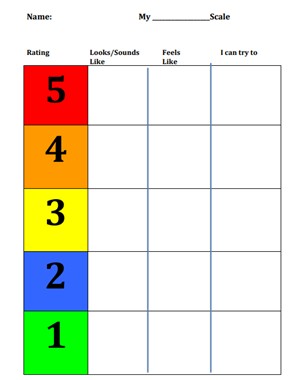
You can learn more about this intervention and the lady who developed it using the link below:
Better Medway School Award
 In order to achieve the award, St Benedict’s had to make a variety of pledges in relation to PSHE and the wellbeing of staff and children and we can say with pride that our school is now a ‘Healthy Setting’.
Our PSHE and Wellbeing coordinator provided a substantial amount of evidence other the course of nearly two years which demonstrated that we:
- We provide an excellent PSHE education for our pupils.
- The mental health of children and staff is at the forefront of everything we do.
- Our children and staff understand the importance of eating healthily and the benefits of nutritious food.
- Our children and staff engage in physical activity on a regular basis and have an excellent knowledge of how this can benefit physical health, mental health and wellbeing.
- Children are encouraged and rewarded to participate in ‘active travel’ and have an excellent understanding of how this can benefit physical health, mental health, wellbeing and the environment.
- Through the School Development Plan, our senior leadership team have demonstrated staff wellbeing is of the upmost importance.
- We have also provided parents and caregivers with numerous opportunities to share their opinions on the education their children receive and we have acted upon advice and feedback provided.
